

What is the Best Kojic Acid Powder?
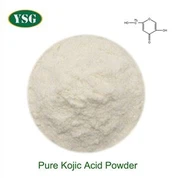
Best Kojic Acid Powder, chemical name is 5-hydroxy-2-hydroxymethyl 1,4-pyrone, Kojic acid is an organic acid with an antibacterial effect produced by microbial aerobic fermentation. It is a weakly acidic compound with a similar molecular structure to glucose. It has been confirmed by isotopes that it is formed by direct oxidation and dehydration of glucose without carbon skeleton breaking. Its acidity is It is derived from its phenolic base structure.

Breeding of the best kojic acid powder producing strains:
Kojic acid was first discovered by Japanese scholars in the brewed soy sauce of Aspergillus oryzae, and later many researchers also isolated kojic acid from the fermentation products of certain strains of Aspergillus flavus, and the yield was higher than that of Aspergillus oryzae. However, when Aspergillus flavus fermented to produce kojic acid, it also produced the strong carcinogen aflatoxin. Scientists studied 149 strains of Aspergillus oryzae and 46 strains of Aspergillus flavus and found that 46 strains of Aspergillus flavus all produced kojic acid, and 34 of them also produced aflatoxin at the same time; while 105 strains of Aspergillus oryzae produced kojic acid, but none of the 149 strains of Aspergillus oryzae produced kojic acid. One produces aflatoxin. Many Aspergillus and a few strains of Penicillium can metabolize to produce kojic acid. Currently, Aspergillus oryzae and Aspergillus flavus that do not produce aflatoxins are commonly used.
Is the best kojic acid powder safe?
Since the date of application of kojic acid, its safety has been a wide concern by relevant scholars. Relevant scholars have said that the pyran in the kojic acid molecule is the same directional compound as benzene, and is theoretically as carcinogenic as benzene. In addition, the hydroxyl group in kojic acid can also accumulate free radicals in the human body, which is also carcinogenic. In particular, Japan, a major producer of kojic acid, which approved the use of kojic acid as a food and pharmaceutical additive in 1988, announced in 2003 that production and import of kojic acid would be suspended until more research results on whether kojic acid was carcinogenic and genotoxic were obtained. After non-pharmaceutical and other products containing kojic acid, more and more scholars are conducting research on the safety of kojic acid.
In recent years, many foreign scholars have carried out a lot of research on genotoxicity, carcinogenicity, embryotoxicity, teratogenicity of kojic acid, and mutagenicity of genetic material. The LD50 of kojic acid is in the range of 1 000 to 1 500 mg/kg. The oral dose of kojic acid was in the range of 300-1 000 mg/(kg·d), and the various clinical physiological and biochemical indicators of male and female rats were normal. No effect was found in necropsy and microscopic observation. Only lymphocytes were observed. and white blood cells decreased slightly. Using the intraperitoneal route of administration, the dose of kojic acid was 300 mg/kg each time. After 14 days, the rat developed a hepatotoxicity pathological phenomenon. The results of studies on the effects of kojic acid on the fertility and embryos of rats are uncertain.
Whether kojic acid has a mutagenic effect on the genetic material of organisms, except for the same conclusion that kojic acid can induce gene mutation in some strains of Salmonella and Bacillus subtilis, different researchers have obtained different conclusions.
Numerous studies have shown that kojic acid-induced thyroid hyperplasia is not associated with genotoxic pathways. Sustained high doses of kojic acid can inhibit the absorption of iodine and induce thyroid hyperplasia and adenoma in mice and rats. Adding kojic acid to food may have the risk of inducing thyroid tumors, but the current test is limited to mice and rats. There is no other animal test evidence. Based on their own experiments and the results of others' research, Burdockl et al. believed that there was a lack of experimental evidence to extend from the continuous high dose of kojic acid that can induce thyroid adenomas in mice and rats to possibly induce thyroid tumors in humans. At the same time, the concentration of kojic acid in food is extremely low, and it should be safe to use under normal circumstances.
The use of Aspergillus oryzae and Aspergillus niger to ferment wine, sauce, soy sauce, and vinegar has a history of more than 2,000 years. The content of kojic acid in these fermented and brewed products is quite low. As far as the kojic acid in these products is concerned, it is not necessary to consume these foods in normal amounts. Special consideration is given to its security.
Hot Tags: best kojic acid powder,kojic acid dipalmitate powder,kojic acid powder for skin whitening,China, suppliers, manufacturers, factory, wholesale, quotation, low price, in stock, buy discount, free sample, made in China